
Looking for an Enzuzo alternative for Shopify? Enzuzo gets a store to a working banner quickly, which is exactly what you want on day one. The trouble starts on day two hundred, when the store has changed and the policies have not, because they were written from a form you filled in once.
This guide compares five options on what matters to a store: native Shopify support, the documents you actually need, page speed at checkout, and what you pay per store.
Enzuzo alternatives for Shopify: at a glance
| Complianz | iubenda | CookieYes | Cookiebot | Termly | |
|---|---|---|---|---|---|
| Shopify support | Native Shopify app, plus a WordPress plugin | Shopify integration, plus WordPress, Webflow and more | Shopify integration | Shopify integration | Shopify integration |
| Documents | Privacy statement, cookie policy, impressum, and terms through a separate free app, region-specific | Policies generated from a scan of the services your store runs, 2,400+ clauses | Cookie policy, privacy policy on paid plans | Privacy and cookie policy only | Wide range, questionnaire-based |
| How documents are built | From your scan results | From a scan, with recurring rescans | From a scan, for cookies only | From a scan, for cookies only | From a questionnaire |
| Region targeting | Geolocation with region-specific banners and documents | Region-aware policies and banners | Geotargeting on paid plans | Geotargeting included | Regional controls included |
| Price | Free plan, paid from €59/year | Free plan, paid from €4.99/month | Free plan, paid from $10/month | Free plan, paid from €7/month | Free plan, paid from $10/month |
| Best for | Stores on Shopify or WordPress that want documents handled natively | Stores that also need data subject requests and accessibility | Stores that want consent handled and documents elsewhere | Stores that mainly need cookie scanning | Stores that mainly need legal documents |
Common reasons Shopify stores compare alternatives
Enzuzo is quick to get live. Three things tend to send stores looking.
Documents come from a questionnaire
Your policies reflect the answers you gave when you set up. Install a new app, add a pixel, or switch fulfilment partners, and the policy does not know. A scanner reads what the store actually runs and rescans as it changes.
The document range is narrow
A store usually needs more than a privacy policy: terms of sale, a return policy, a shipping policy, an impressum in some markets. Each one Enzuzo does not generate is another thing to write or buy.
Features sit on higher tiers
Advanced features and customization are held back for higher plans, and support is live chat only on most tiers. Reviewers also mention banner display issues.
The cost of fragmentation
Running consent in one app and documents in another means two subscriptions and two update cycles, and the maintenance load grows every time a regulation changes.
Every app you add is another tracker to disclose and another clause to get right. A setup where consent and documents come from the same scan keeps up with that on its own; two separate tools do not.
What to check before you switch
Four things worth confirming first.
Native Shopify support
An app built for Shopify behaves predictably with your theme and your checkout. An integration bolted on afterwards is where display problems come from.
The document list
Check specifically which documents each option generates. This is where the options differ most, and where stores get caught out.
Page speed at checkout
A slow banner on a product page costs you attention. A slow banner near checkout costs you orders.
What sits behind the next tier
Check which features are held back and what the step up costs, before the store grows into it.
The five alternatives
1) Complianz
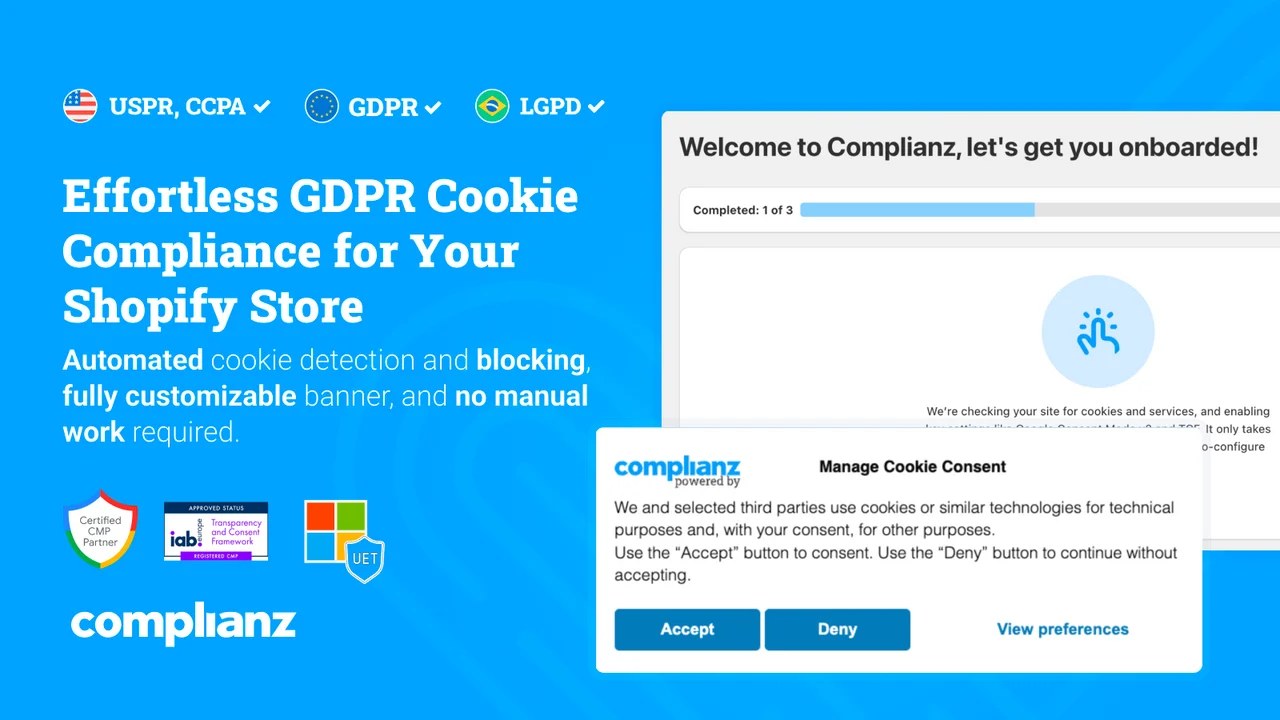
Complianz runs natively on both Shopify and WordPress, which matters if your store and your content site are on different platforms. The documents come from a scan of what the store actually runs rather than from a setup questionnaire.
Regional differences are handled by geolocation, so a store selling into several markets shows the right banner and the right policy in each.
Pros
- Native on Shopify and on WordPress, not an integration bolted onto one
- Documents from your scan rather than a questionnaire
- Region-specific banners and documents for multi-market stores
- Consent statistics and A/B testing included
- 30-day money-back guarantee
Cons
- No coverage outside WordPress and Shopify
- Terms and conditions come from a second, free app
Pricing
- Free plan available
- Paid plans from €59/year, under €5 a month
How does Complianz compare to Enzuzo?
Complianz is a native app on Shopify and a native plugin on WordPress, which matters if you run both, and it generates documents from your own scan results rather than from a form.
Documents adapt by region through geolocation, so a store selling into the EU, the UK and the US shows the right banner and the right policy in each.
Best for: stores on Shopify or WordPress that want consent and documents handled natively.
2) iubenda
iubenda covers the document range a store actually needs, built from a scan of the apps and services running on it, and adds data subject request handling on the same subscription.
It integrates with Shopify and with everything else, which suits a merchant running a storefront alongside a separate content site.
Pros
- Document range built for commerce, generated from your scan
- Data subject request handling included rather than tiered
- Works across Shopify, WordPress, Webflow and custom stacks
- Accessibility and whistleblowing on the same subscription
Cons
- Configuration lives in the iubenda dashboard
- More than a single small store usually needs
Pricing
- Free plan available
- Paid plans from €4.99/month billed yearly, or €5.99 month to month
How does iubenda compare to Enzuzo?
iubenda covers the document range a store actually needs, generated from a scan of the services running on it, and adds data subject requests and accessibility on the same subscription.
It integrates with Shopify and with everything else, which suits a merchant running a storefront and a separate content site.
Best for: merchants running a storefront and a content site who want both covered by one account.
3) CookieYes
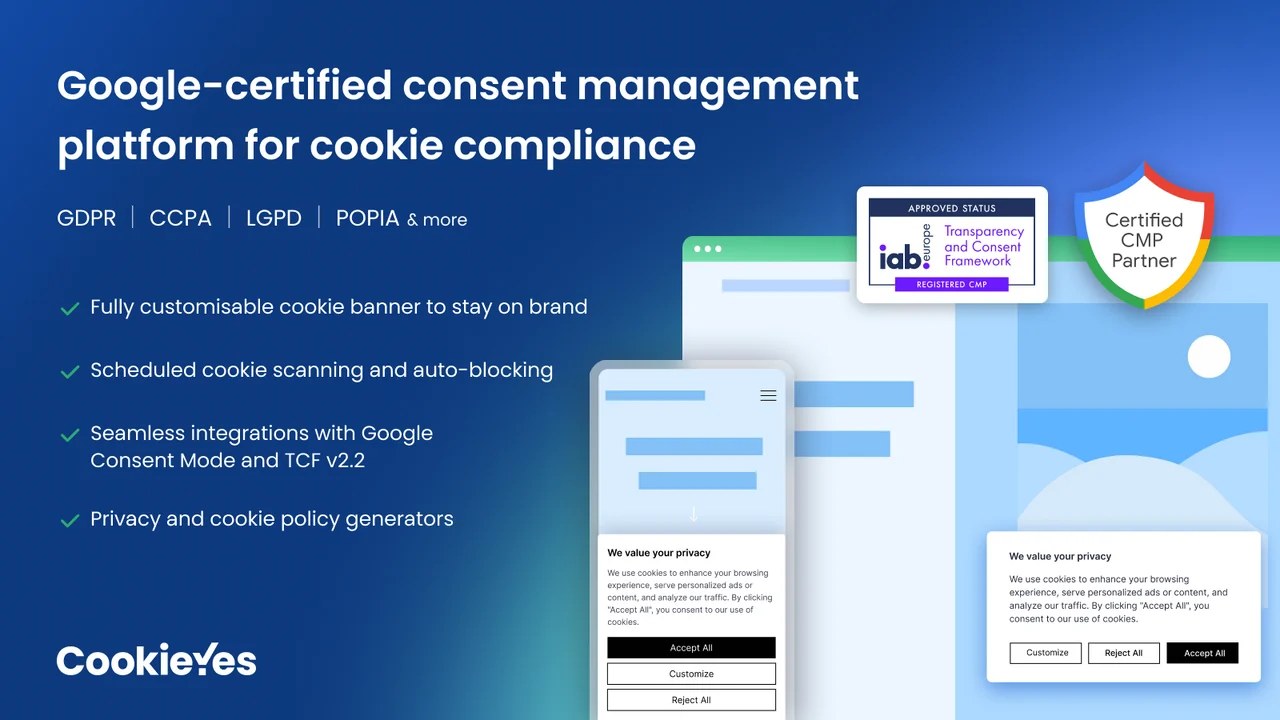
CookieYes is the quickest of these to install, and its scope is the banner itself. Stores that also need documents or data subject request handling will cover those elsewhere.
Pros
- Quick to install and configure
- A free plan that covers a small store
- Script blocking and consent logs
Cons
- No data subject request handling, so every deletion request a customer sends is handled by hand
- Documents are narrower than Enzuzo’s, so the gap that sends stores looking gets wider, not smaller
- Nothing for terms of sale, returns or shipping, which a storefront needs before it needs a cookie banner
- Support-forum threads report banners not displaying reliably
Pricing
- Free plan available
- Paid plans from $10/month
How does CookieYes compare to Enzuzo?
CookieYes is the quickest of these to install, and that is most of what it offers a store. The banner works and the free tier covers a small catalogue.
Its document range is narrower than Enzuzo’s and it has no data subject request handling. Stores looking to solve the paperwork will want one of the two that generate documents from a scan.
Best for: stores that only ever wanted the banner and keep their documents somewhere else.
4) Cookiebot
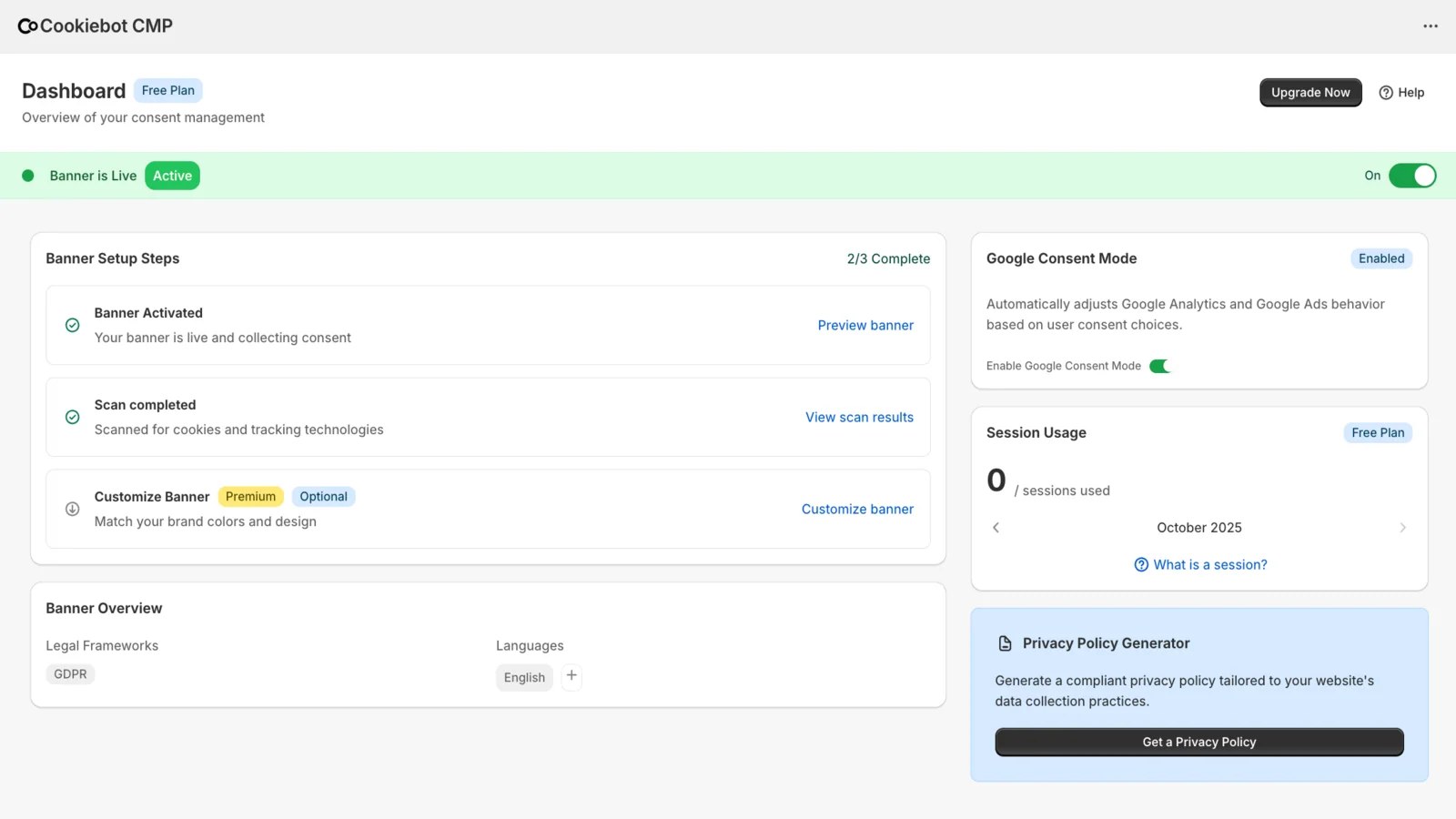
Cookiebot brings a stronger scanner and geotargeting than Enzuzo, which suits a store selling into several markets.
Pros
- A strong scanner with automatic categorization
- Geotargeting for multi-market stores
- Cross-domain consent sharing
Cons
- Priced by page count, so every product, variant and collection page you add raises the bill
- A growing catalogue can cross a tier without anything else about the store changing
- Document generation stops at two policies, so the store document gap remains
- No native Shopify app
Pricing
- Free plan available
- Paid plans from €7/month
How does Cookiebot compare to Enzuzo?
Cookiebot has a stronger scanner than Enzuzo and adds geotargeting, which helps if accuracy or regional rules were your reason for leaving.
The catch is the pricing, and it catches stores harder than most sites. Cookiebot counts pages, and a catalogue is mostly pages: every product, variant and collection URL counts, so the bill grows as you add stock. Its documents also stop at privacy and cookie policies, so the gap that sent you looking is still there.
Best for: stores with a small catalogue that need scanning accuracy above anything else.
5) Termly
Termly is the document-heavy option for a store: terms, returns and shipping policies alongside the privacy and cookie set, which is more than most consent tools attempt.
Pros
- Return and shipping policies that most consent tools do not generate
- A free plan with capped monthly pageviews
- Cookie scanning and script blocking
Cons
- Questionnaire-based, which is the exact method you are leaving Enzuzo over
- The documents describe the store you described, so every new app or pixel puts them further out of date
- Reviewers report slower page loads on larger sites, and a slow banner near checkout costs orders
- No native Shopify app, so it sits alongside your store rather than inside it
Pricing
- Free plan with capped monthly pageviews
- Paid plans from $10/month
How does Termly compare to Enzuzo?
Termly generates the widest document range here, which is the thing Enzuzo users most often want, and it is the reason it keeps turning up on these shortlists.
It also builds them the same way Enzuzo does, from a questionnaire. You would be paying to move your documents from one form to another form, and they would go stale in exactly the same way. Reviewers report slower page loads on larger sites too, which on a store is a checkout problem rather than a cosmetic one.
Best for: stores that want the widest document list and can live with keeping it current themselves.
Choosing the right one for your store
Four questions to work through.
- Was the questionnaire the problem? Complianz, iubenda, CookieYes and Cookiebot all scan. Termly does not.
- Do you need terms of sale, returns and shipping policies? Only Complianz, iubenda and Termly go that wide.
- Do you ship outside your own market? The rules that apply follow your customers, not your registration, and one banner rarely satisfies all of them.
- Do you run a content site as well as the store? Complianz covers both natively. iubenda covers both and more.
If the documents were why you started looking, only Complianz and iubenda actually solve it, because they are the two that read your store instead of asking you to describe it.
Frequently asked questions
What is the best Enzuzo alternative for Shopify?
For a store that needs documents as well as consent, Complianz, because it is native on Shopify and generates the documents from your own scan results. If you also need data subject requests or accessibility, iubenda covers those on one subscription.
Why do stores move away from Enzuzo?
Three reasons come up most: documents are built from a questionnaire rather than a scan, the document range is narrower than a store usually needs, and advanced features sit behind higher tiers.
Do I need a cookie banner on Shopify?
If your store sets cookies that are not strictly necessary, and you have customers in regions whose rules require consent, then regulations require you to ask before those cookies are set. Shopify does not do this for you by default.
Will switching affect my checkout?
It should not, if the app is built for Shopify. Test on a duplicate theme first, and keep the old app installed but disabled until the new banner is confirmed working on product and checkout pages.
A setup that keeps up with the store
A store changes every week: new apps, new pixels, new markets, new products. Consent that blocks the right scripts, a banner that suits the region, and documents that describe what is actually running are one job, not three, and Complianz handles them from a single scan inside your store.
Install Complianz. There is a free plan to test on and paid plans start at under €5 a month, billed per year rather than against your traffic.